
Imagine you are preparing to move a concentrated position across three chains for an arbitrage or to rebalance liquidity pools. The dApp you need lives on Arbitrum, you have gas on Ethereum Mainnet and BNB Chain, and the smart contract you plan to interact with recently received a security alert on Discord. In that moment you face three practical risks: blind signing a harmful call, paying gas on the wrong chain, or retaining overly broad token approvals that an attacker could exploit. This article walks through installing and configuring the Rabby wallet extension in a US desktop environment so you can see how its design — especially transaction simulation, approval revocation, and cross-chain gas top-up — changes real operational trade-offs for power users.
We’ll use a single concrete scenario to reveal mechanisms: importing an existing MetaMask seed into the Rabby extension, enabling hardware-wallet protection, using automatic network switching to interact with a DeFi aggregator, simulating the pending transaction to verify token flows and fees, and finally revoking an old approval. Where Rabby shines I’ll explain why, and where it still forces you to accept trade-offs (no fiat on-ramp, no native staking). The goal is a reusable mental model you can apply to other multi-chain workflows.
Step-by-step: install, import, and secure
On a Chromium-based browser (Chrome, Brave, Edge) add the Rabby extension as you would any wallet extension. During install you’ll be offered options to create a new wallet or import an existing one via seed phrase or private key. For power-user hygiene: import your seed only in a secure workstation, ideally with a hardware wallet (Rabby supports Ledger, Trezor, Keystone and others) attached. If you rely on an institutional signer, Rabby’s integrations (Gnosis Safe, Fireblocks) allow you to retain multi-sig control while using Rabby’s interface for simulations and revocations.
Rabby also provides a Flip toggle so power users can switch between Rabby and MetaMask as the default extension without reimporting accounts. That’s a small but effective operational convenience when different dApps behave better with different providers.
Mechanism deep-dive: how Rabby’s transaction simulation works and why it matters
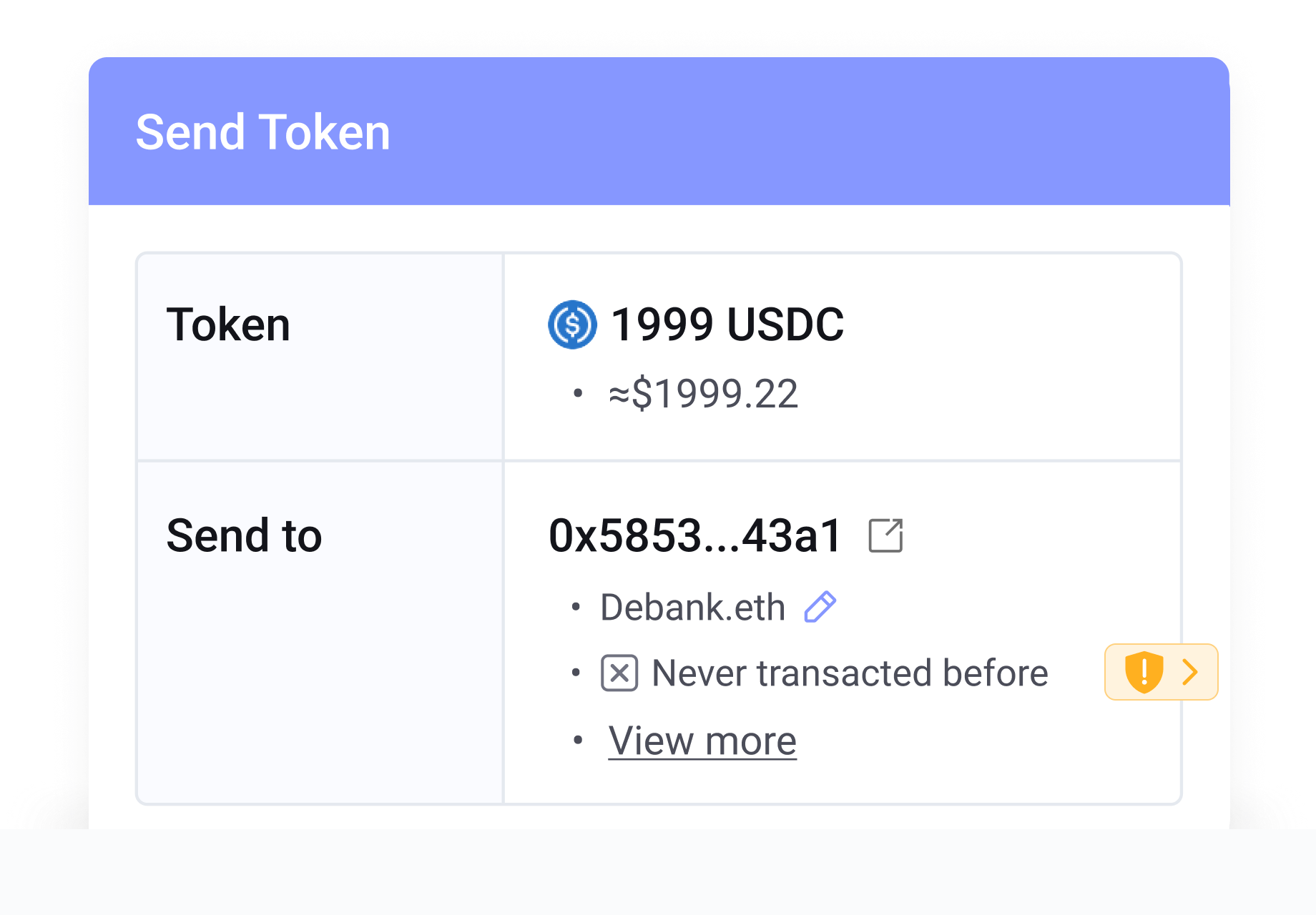
Blind signing is a known vector for losses: users approve transactions without seeing the exact token and balance changes. Rabby prevents this by running a local simulation of the pending transaction before it is signed. The simulation evaluates the call data, queries on-chain state, and projects token balance deltas and the fee. That projection is presented in human-readable terms: which token goes where, how fees are paid, and any abnormal recipient addresses or approval requests.
Why this matters in practice: simulations convert an abstract EVM call into a numeric delta you can reason about. Instead of trusting a dApp UI that might be compromised or outdated, you get an independent check. For example, a swap that purports to exchange USDC for WETH but actually includes an extra transfer to an unknown address will show a negative WETH and an unexplained outgoing transfer in the simulation. That explicitness changes the decision predicate from “do I trust this UI?” to “do the simulated deltas match the trade I intended?”
Limitations and boundary conditions: simulation accuracy depends on access to up-to-date on-chain state and deterministic execution assumptions. Complex contracts that rely on off-chain oracles, dynamic randomness, or time-dependent conditions may produce simulations that diverge from final execution. Rabby’s simulation reduces but does not eliminate risk; it is an additional inspection layer, not formal verification.
Approval management and exposure control
Another common operational failure is excessive ERC-20 approvals — long-lived allowance grants to routers or contracts that, if compromised, permit full token drains. Rabby’s built-in approval revocation tool enumerates active approvals and lets you reduce or cancel them directly from the wallet. Mechanically this is a read of allowance mappings plus a convenience UI to submit approval(0) or limited-allowance transactions.
Trade-offs: revoking approvals means writing transactions and paying gas; if you revoke too aggressively you may break legitimate automated flows (e.g., a market-making bot). A pragmatic heuristic: revoke approvals for contracts you no longer use, and replace permanent approvals with time- or amount-limited allowances when interacting with new or large-value protocols.
Cross-chain gas top-up and automatic network switching
Power-users frequently juggle gas shortages on L2s or sidechains. Rabby’s cross-chain gas top-up lets you send native gas tokens to another network from within the wallet — simplifying a common operational friction when you need to execute a time-sensitive transaction but lack gas on the target chain. Technically, this is facilitated by a bridge-like mechanism or a custodial relayer; check the wallet prompts to understand routing and fees for top-up operations.
Automatic network switching complements this by detecting which chain a dApp requires and switching the extension to that network. That reduces accidental transactions on the wrong chain, a small but costly human-error source. Again, power users should confirm the simulation after switching; automatic switching reduces friction but does not remove the need for inspection.
Installation and download choices — desktop, mobile, and extension trade-offs
Rabby offers a browser extension, desktop client (Windows, macOS), and mobile apps (iOS, Android). For DeFi power users executing complex multi-step flows, the extension or desktop client combined with a hardware wallet gives the best operational balance: strong UX, easy multi-window workflows, and hardware signing. Mobile is convenient for monitoring and quick approvals but increases the attack surface if used for high-value signing without hardware backing.
Open-source status matters: Rabby is MIT-licensed, so its code is available for third-party audit and community review. That transparency lowers systemic risk compared with opaque, closed-source wallets, but open-source does not equal secure by default; quality of audits and response processes matter. Rabby’s response to its 2022 Rabby Swap exploit — freezing the contract, compensating users, and increasing audits — is a relevant data point: it shows an operational response but also illustrates that even wallets and their adjacent contracts carry exploitable elements.
Decision framework: when to use Rabby vs. alternatives
Use Rabby when you value transaction-level transparency and multi-chain convenience: extensive EVM chain support (90+ networks), simulations, approval management, automatic network switching, hardware wallet compatibility, and integrations for institutional custody. Choose an alternative (MetaMask, Trust Wallet, Coinbase Wallet) when you need native fiat on-ramps, in-wallet staking, or an ecosystem-specific feature set not present in Rabby.
Heuristic for power users: if your workflows involve large-value or multi-step DeFi interactions across chains, prioritize a wallet with simulation and approval revocation (i.e., Rabby). If you want frictionless fiat-to-crypto purchasing inside the wallet, use an exchange-hosted wallet or a wallet with integrated on-ramp, and then move funds on-chain to a simulated-capable wallet for trading.
For a straightforward download and to read more about installer options and platform releases, see the official Rabby extension and client page: rabby wallet.
What to watch next — signals and near-term implications
Signals that would change how you use Rabby: expansion of native fiat rails inside the wallet would make Rabby a primary on-ramp, altering custody trade-offs; deeper on-chain formal verification tools integrated with simulations would further reduce blind-signing risk; and more institutional adoption (multi-sig integrations, enterprise relayers) would shift Rabby from a power-user tool to an institutional standard. Conversely, new classes of smart-contract exploits that target wallet-side tooling (e.g., malicious simulation-manipulating relayers) would raise fresh threat models to monitor.
Practically: stay alert to Rabby’s release notes about changes to cross-chain top-up mechanisms and any shifts in which relayers or bridges the wallet uses; those are where counterparty and execution risks live.
FAQ
Can I import my MetaMask account into Rabby safely?
Yes. Rabby supports importing accounts via seed phrase or private key. Best practice: import on a secure machine, pair the account with a hardware wallet for signing if possible, and avoid entering seeds on public or untrusted devices. Use Rabby’s Flip toggle if you want to switch defaults without reimporting accounts.
Does Rabby prevent all smart-contract exploits?
No. Rabby’s pre-transaction risk scanning and simulation reduce common human-error and simple exploit vectors (blind signing, suspicious approvals), but they cannot guarantee safety against novel or on-chain oracle attacks, logic-level contract bugs, or exploits that depend on off-chain inputs. Treat Rabby as a risk-reduction tool within a broader security posture (hardware wallets, multi-sig, minimal approvals).
Is there a fiat on-ramp in Rabby?
Not currently. Rabby lacks a built-in fiat on-ramp and does not offer native in-wallet fiat purchases. Users in the US will need to buy crypto on an exchange or on-ramp service and then transfer assets into Rabby.
How reliable are Rabby’s transaction simulations?
Simulations are reliable for deterministic EVM calls that depend only on on-chain state. They can be less accurate for contracts relying on oracles, randomness, or complex off-chain coordination. Use simulations as a strong inspection layer but not as a formal proof; for very large transactions consider additional audits or staged small-value tests.

